
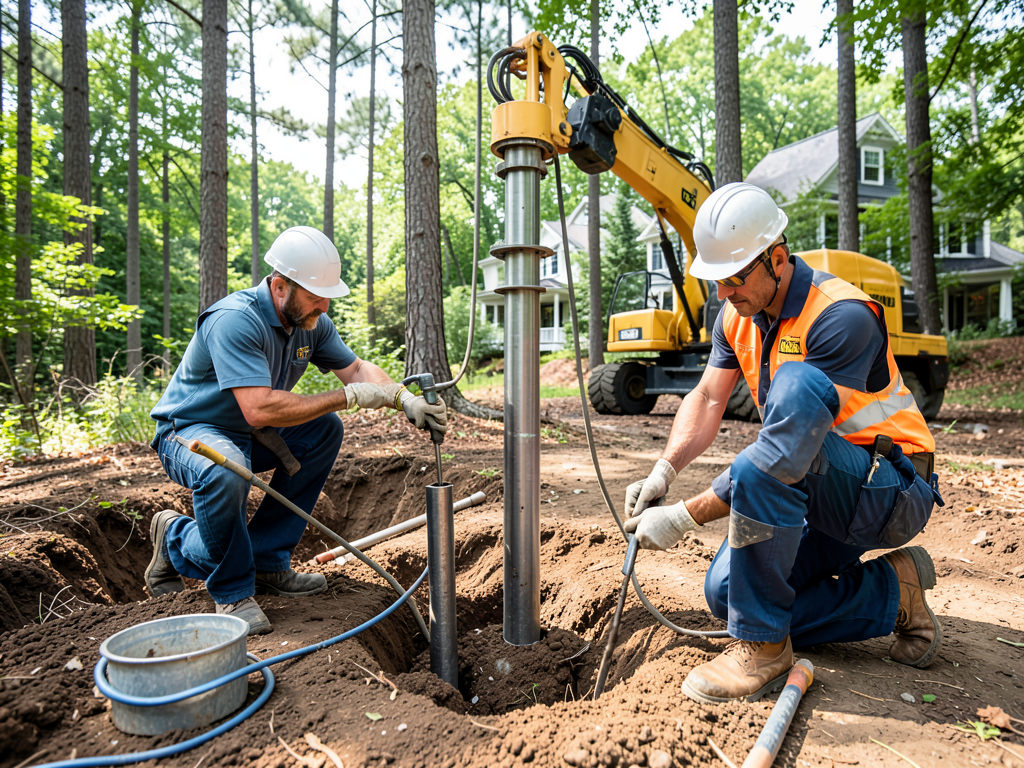
Expert Geothermal HVAC Installation in Indian Hill, Ohio
Indian Hill’s sprawling estates and wooded lots create the perfect environment for geothermal heating and cooling systems. With property sizes often exceeding one acre, these estates can harness the earth’s stable underground temperature to deliver year-round comfort while cutting energy costs by up to 70%. Our team specializes in designing and installing closed-loop ground source heat pump systems specifically engineered for the heavy clay soil and limestone bedrock common throughout the 45243 ZIP code. Cooling Tower Services.
The unique geology of Indian Hill means your geothermal system will operate with maximum efficiency. The area’s clay-heavy soil provides excellent thermal conductivity, allowing heat exchange to occur more rapidly than in sandy soils. Combined with the consistent underground temperatures maintained by the limestone layer, your system will deliver reliable performance through Cincinnati’s dramatic seasonal swings from polar vortex winters to 90+ degree summers. How to find a reliable AC repair company in Hyde Park without overpaying.
Investing in geothermal technology for your Indian Hill estate means more than just lower utility bills. These systems operate with near-silent performance, eliminating the outdoor compressor noise that can disrupt the peaceful atmosphere of your property. The absence of exposed outdoor equipment also preserves your landscape’s aesthetic, maintaining the natural beauty that makes Indian Hill so desirable.
Why Indian Hill Homeowners are Switching to Ground Source Heat Pumps
Homeowners across Indian Hill are discovering that ground source heat pumps offer advantages that traditional HVAC systems simply cannot match. The most compelling benefit is the dramatic reduction in operating costs. While the initial investment exceeds conventional systems, the 50-70% energy savings typically pay for the installation within 5-7 years, leaving you with decades of reduced utility bills.
The environmental impact cannot be overstated. A typical geothermal system eliminates approximately 7 metric tons of carbon emissions annually compared to a conventional furnace and air conditioner. For environmentally conscious Indian Hill residents who value the area’s natural beauty, this represents a meaningful reduction in your carbon footprint without sacrificing comfort. Emergency furnace repair services for Indian Hill homeowners available right now.
System longevity provides another compelling reason to invest. While traditional HVAC equipment requires replacement every 12-15 years, geothermal heat pump components typically last 20-25 years, with the underground loop system functioning for 50+ years. This extended lifespan means fewer replacements, less waste, and more predictable long-term costs for your estate.
The comfort level delivered by ground source heat pumps exceeds conventional systems in several ways. These units provide consistent temperatures without the hot and cold spots common with traditional systems. The gradual heating and cooling cycles eliminate the temperature swings that can make some rooms uncomfortable. Additionally, the systems excel at dehumidification, removing excess moisture from your home during humid Cincinnati summers.
Modern geothermal systems integrate seamlessly with smart home technology. You can monitor and control your system remotely, track energy usage patterns, and even receive predictive maintenance alerts. This connectivity allows you to optimize performance based on your specific usage patterns and the unique characteristics of your Indian Hill property. Furnace Maintenance Checklist.
Navigating Indian Hill Zoning and Geothermal Permits
Installing a geothermal system in Indian Hill requires understanding specific local regulations. The Village of Indian Hill Building Department oversees all geothermal installations, requiring permits for both the underground loop system and the indoor heat pump unit. The permitting process typically takes 2-3 weeks and includes review of your site plan, system design, and environmental impact assessment.
Property setbacks represent a critical consideration for Indian Hill estates. The Village requires that all underground loop installations maintain minimum distances from property lines, septic systems, and existing structures. For vertical loop systems, which are common on properties under 2 acres, the drilling must avoid underground utilities and maintain appropriate spacing between boreholes to prevent thermal interference.
Soil disturbance regulations in Indian Hill are particularly stringent due to the area’s emphasis on preserving natural landscapes. Any excavation must include erosion control measures, and the site must be restored to its original condition or better. This means your geothermal installation will include comprehensive landscaping restoration, ensuring your property maintains its pristine appearance throughout the installation process.
Water rights considerations apply if you’re considering an open-loop system. While less common than closed-loop systems, open-loop installations require additional permits from the Ohio EPA and must demonstrate that water extraction will not impact local aquifers or neighboring properties. Most Indian Hill installations use closed-loop systems to avoid these complications.
The Village of Indian Hill has embraced green building initiatives, and geothermal installations often qualify for streamlined permitting when they’re part of larger energy efficiency improvements. Properties incorporating multiple sustainable features may qualify for expedited review, reducing the overall timeline for your installation project.
Insurance considerations also factor into your planning. Some homeowner’s insurance policies require notification when installing geothermal systems, particularly for the underground components. Our team works directly with your insurance provider to ensure all necessary documentation is provided and that your coverage remains intact throughout the installation process.
Vertical vs. Horizontal Loops: What’s Best for Your Cincinnati Property?
The choice between vertical and horizontal loop systems depends primarily on your available land area and soil conditions. Indian Hill’s larger estate lots often provide options for both configurations, though specific property characteristics will determine the optimal approach for your installation.
Horizontal loop systems require trenches 3-6 feet deep and work well on properties with at least one acre of open land. These systems typically cost less to install than vertical loops because they don’t require specialized drilling equipment. However, they need more surface area and can disturb more of your existing landscape during installation.
Vertical loop systems involve drilling boreholes 150-400 feet deep, making them ideal for properties where horizontal space is limited or where extensive landscaping must be preserved. These systems work exceptionally well in Indian Hill’s limestone-rich soil, where drilling conditions are favorable and the thermal properties of the rock enhance system efficiency.
The decision often comes down to your specific property characteristics. Properties with significant tree cover or existing structures may benefit from vertical loops that minimize surface disruption. Conversely, open fields or large lawns can accommodate horizontal loops that reduce drilling costs while still delivering excellent performance.
Soil composition plays a crucial role in system design. Indian Hill’s heavy clay soil provides excellent thermal conductivity, meaning both loop types will operate with high efficiency. The clay’s moisture retention properties actually enhance heat transfer compared to sandy soils, potentially allowing for smaller loop fields and reduced installation costs.
Water table considerations affect loop design in certain areas of Indian Hill. Properties near creeks or in low-lying areas may have higher water tables that influence the depth and configuration of your loop system. Our engineers conduct thorough site assessments to determine how local hydrology will impact your installation.
Climate factors specific to Cincinnati also influence the optimal loop configuration. The area’s significant seasonal temperature variations mean your system must be sized to handle both extreme summer cooling loads and winter heating demands. Properties with extensive south-facing glass or additional heat gain from indoor pools may require larger loop fields to maintain efficiency during peak loads.
Future expansion plans should factor into your loop design. If you’re considering home additions, pool installations, or other property improvements, your geothermal system can be designed with expansion capacity to accommodate increased heating and cooling loads without requiring major modifications later.
Federal Tax Credits and Local Ohio Incentives
The federal government currently offers a 30% tax credit for residential geothermal heat pump installations under the Residential Clean Energy Credit. This credit applies to the total system cost, including equipment, labor, and necessary electrical upgrades. For a typical Indian Hill estate installation costing $40,000-$80,000, this represents a $12,000-$24,000 credit directly applied to your federal tax liability.
Ohio’s energy efficiency programs complement the federal incentives. Duke Energy offers rebates for geothermal installations that meet specific efficiency criteria, typically ranging from $200-$500 depending on the system’s coefficient of performance. These utility rebates are available to both electric and gas customers, making geothermal an attractive option regardless of your current energy provider.
The tax credit structure allows you to claim the credit in the year the system is placed in service, even if you’re financing the installation. This means you can benefit from the full credit while making monthly payments, effectively reducing your out-of-pocket costs during the critical first years of ownership.
State-level incentives vary annually, but Ohio frequently offers additional programs for renewable energy installations. The Ohio Development Services Agency periodically provides grants or low-interest financing for energy efficiency improvements, which can be combined with the federal tax credit to further reduce your net investment.
Local utility programs specific to Hamilton County sometimes offer additional incentives for geothermal installations. These programs often focus on reducing peak demand during summer months, when Cincinnati’s electrical grid experiences the highest stress. Participating in these programs can provide ongoing credits on your utility bills beyond the initial installation incentives.
Property tax considerations vary by jurisdiction. While the federal tax credit provides immediate benefits, some Indiana Hill residents worry about potential property tax increases due to the added home value from a geothermal system. However, Ohio’s renewable energy property tax exemption means your geothermal installation won’t increase your property tax assessment for the first 10 years. Why Mason residents trust us for their annual HVAC maintenance and tune-ups.
Financing options have expanded significantly for geothermal installations. Many local banks and credit unions now offer specialized green energy loans with terms specifically designed for geothermal projects. These loans often feature lower interest rates and longer terms than conventional home improvement financing, making the monthly payments more manageable.
Energy savings calculations demonstrate the long-term financial benefits. A typical 4,000 square foot Indian Hill estate can expect to save $1,500-$2,500 annually on heating and cooling costs compared to conventional systems. When combined with the tax credits and rebates, these savings create a compelling return on investment that typically exceeds 15% annually over the system’s lifetime.
Our Indian Hill Geothermal Project Gallery
Our team has completed numerous geothermal installations throughout Indian Hill, each tailored to the specific characteristics of the property and the homeowner’s requirements. These projects demonstrate the versatility of geothermal technology across different property sizes and configurations within the 45243 ZIP code.
Properties along Shawnee Run Road often feature the classic combination of mature trees and rolling terrain that makes vertical loop systems particularly effective. These installations typically involve drilling 3-4 boreholes to depths of 250-350 feet, with the underground components completely concealed to preserve the natural landscape character that defines this area.
Larger estates near Drake Road frequently opt for horizontal loop systems that take advantage of the open acreage while minimizing installation costs. These projects often incorporate the excavation work into other property improvements, such as drainage system upgrades or landscape renovations, creating additional value beyond the geothermal installation itself.
Historic properties in the village center present unique challenges that our team has mastered through years of experience. These installations require careful coordination with preservation guidelines while still delivering modern efficiency. We’ve successfully integrated geothermal systems into homes built in the 1920s and 1930s, preserving architectural integrity while dramatically improving energy performance.
Modern construction projects throughout Indian Hill increasingly specify geothermal systems from the outset. These installations benefit from integrated design approaches that optimize ductwork layout, mechanical room placement, and loop field configuration during the initial construction phase, resulting in lower overall costs and superior system performance.
Multi-building estates represent some of our most complex projects, requiring sophisticated hydraulic separation and control strategies. These installations often serve main residences, guest houses, and pool houses from a single ground loop field, demonstrating the scalability of geothermal technology for even the most demanding applications.
Commercial properties within Indian Hill, including office buildings and small business campuses, have also adopted geothermal technology. These installations often qualify for additional incentives through Ohio’s commercial energy efficiency programs and can provide even faster payback periods due to their larger scale and higher usage patterns.
Each project includes comprehensive documentation and training for the homeowner. We provide detailed system manuals, maintenance schedules, and performance monitoring tools that allow you to track your energy savings and system efficiency over time. This educational component ensures you maximize the benefits of your investment for decades to come.
Frequently Asked Questions
How long does a geothermal installation take in Indian Hill?
Most residential geothermal installations in Indian Hill require 2-4 weeks from start to finish, depending on the system size and loop configuration. Vertical loop systems may require additional time for drilling operations, while horizontal systems can often be completed more quickly if weather conditions are favorable.
Will a geothermal system work during power outages?
Standard geothermal systems require electricity to operate the heat pump and circulation pumps. However, many Indian Hill homeowners install backup generators specifically sized to power their geothermal systems during outages, ensuring continuous operation even during severe weather events that might affect the area.
What maintenance does a geothermal system require?
- Annual Professional Inspection
Schedule yearly service to check refrigerant levels, electrical connections, and system controls. This prevents minor issues from becoming major problems.
- Filter Replacement
Replace air filters every 3-6 months depending on usage and indoor air quality. Clean filters maintain system efficiency and protect indoor air quality.
- Loop System Monitoring
Check pressure and temperature differentials in the loop system annually. Unusual readings can indicate developing problems before they impact performance.
Geothermal systems require minimal maintenance compared to conventional HVAC equipment. The underground loop system is essentially maintenance-free, while the indoor heat pump unit needs only annual professional service and regular filter changes.
Can I install geothermal in an existing home?
Yes, geothermal systems can be retrofitted into existing Indian Hill homes. The installation process involves evaluating your current ductwork, electrical service, and available land for the loop field. Many retrofits actually improve overall home comfort by addressing duct issues and providing better humidity control than the original system.
Ready to Transform Your Indian Hill Estate’s Comfort and Efficiency?
Geothermal heating and cooling represents the ultimate investment in your Indian Hill property’s comfort, efficiency, and environmental responsibility. With energy savings of 50-70%, near-silent operation, and systems that last 25+ years, the decision becomes clear when you consider the long-term benefits for your estate.
Our team brings decades of experience specifically with Indian Hill properties, understanding the unique challenges and opportunities presented by the area’s soil conditions, zoning requirements, and architectural diversity. We handle everything from initial design through final commissioning, ensuring your system performs exactly as promised.
The combination of federal tax credits, local incentives, and dramatic energy savings makes now the ideal time to invest in geothermal technology. Most installations pay for themselves within 5-7 years while providing decades of reliable, efficient comfort for your family.
Don’t wait for another season of high energy bills or system failures. Call (513) 717-5155 today to schedule your free geothermal consultation. Our experts will evaluate your property, explain your options, and provide a detailed proposal with accurate cost estimates and projected energy savings. Take the first step toward transforming your Indian Hill estate’s comfort and efficiency with geothermal technology that’s built to last generations.
Pick up the phone and call (513) 717-5155 before the next heating season arrives. Your estate deserves the comfort, efficiency, and reliability that only geothermal technology can provide. We’re ready to show you exactly how this investment will pay dividends for decades to come. For more information, visit Energy.gov geothermal heat pump guide. For more information, visit International Ground Source Heat Pump Association.
{
“@context”: “https://schema.org”,
“@type”: “BlogPosting”,
“headline”: “Investing in geothermal heating and cooling for your Indian Hill estate”,
“description”: “Discover expert geothermal HVAC installation for Indian Hill estates. Learn about ground source heat pumps, local permits, tax credits, and ROI for Cincinnati’s high-end properties.”,
“wordCount”: 2600,
“datePublished”: “2026-03-01T16:54:00.000Z”,
“dateModified”: “2026-03-01T16:54:00.000Z”,
“inLanguage”: “en-US”,
“mainEntityOfPage”: {
“@type”: “WebPage”,
“@id”: “https://fivestarhvaccincinnati.com”
},
“publisher”: {
“@type”: “LocalBusiness”,
“name”: “Five Star HVAC Cincinnati”,
“url”: “https://fivestarhvaccincinnati.com”
},
“author”: {
“@type”: “Organization”,
“name”: “Five Star HVAC Cincinnati”,
“url”: “https://fivestarhvaccincinnati.com”
},
“image”: {
“@type”: “ImageObject”,
“url”: “https://fivestarhvaccincinnati.com/wp-content/uploads/2026/03/investing-in-geothermal-heating-and-cooling-for-yo-1.png”
}
}
{
“@context”: “https://schema.org”,
“@type”: “HVACBusiness”,
“name”: “Five Star HVAC Cincinnati”,
“url”: “https://fivestarhvaccincinnati.com”,
“address”: {
“@type”: “PostalAddress”,
“addressLocality”: “Cincinnati”
},
“areaServed”: {
“@type”: “City”,
“name”: “Cincinnati”
}
}
{
“@context”: “https://schema.org”,
“@type”: “FAQPage”,
“mainEntity”: [
{
“@type”: “Question”,
“name”: “Vertical vs. Horizontal Loops: What’s Best for Your Cincinnati Property?”,
“acceptedAnswer”: {
“@type”: “Answer”,
“text”: “The choice between vertical and horizontal loop systems depends primarily on your available land area and soil conditions. Indian Hill’s larger estate lots often provide options for both configurations, though specific property characteristics will determine the optimal approach for your installation.”
}
},
{
“@type”: “Question”,
“name”: “How long does a geothermal installation take in Indian Hill?”,
“acceptedAnswer”: {
“@type”: “Answer”,
“text”: “Most residential geothermal installations in Indian Hill require 2-4 weeks from start to finish, depending on the system size and loop configuration. Vertical loop systems may require additional time for drilling operations, while horizontal systems can often be completed more quickly if weather conditions are favorable.”
}
},
{
“@type”: “Question”,
“name”: “Will a geothermal system work during power outages?”,
“acceptedAnswer”: {
“@type”: “Answer”,
“text”: “Standard geothermal systems require electricity to operate the heat pump and circulation pumps. However, many Indian Hill homeowners install backup generators specifically sized to power their geothermal systems during outages, ensuring continuous operation even during severe weather events that might affect the area.”
}
},
{
“@type”: “Question”,
“name”: “Can I install geothermal in an existing home?”,
“acceptedAnswer”: {
“@type”: “Answer”,
“text”: “Yes, geothermal systems can be retrofitted into existing Indian Hill homes. The installation process involves evaluating your current ductwork, electrical service, and available land for the loop field. Many retrofits actually improve overall home comfort by addressing duct issues and providing better humidity control than the original system.”
}
},
{
“@type”: “Question”,
“name”: “Ready to Transform Your Indian Hill Estate’s Comfort and Efficiency?”,
“acceptedAnswer”: {
“@type”: “Answer”,
“text”: “Geothermal heating and cooling represents the ultimate investment in your Indian Hill property’s comfort, efficiency, and environmental responsibility. With energy savings of 50-70%, near-silent operation, and systems that last 25+ years, the decision becomes clear when you consider the long-term benefits for your estate.”
}
}
]
}
{
“@context”: “https://schema.org”,
“@type”: “HowTo”,
“name”: “Geothermal System Maintenance”,
“step”: [
{
“@type”: “HowToStep”,
“position”: 1,
“name”: “Annual Professional Inspection”,
“text”: “Schedule yearly service to check refrigerant levels, electrical connections, and system controls. This prevents minor issues from becoming major problems.”
},
{
“@type”: “HowToStep”,
“position”: 2,
“name”: “Filter Replacement”,
“text”: “Replace air filters every 3-6 months depending on usage and indoor air quality. Clean filters maintain system efficiency and protect indoor air quality.”
},
{
“@type”: “HowToStep”,
“position”: 3,
“name”: “Loop System Monitoring”,
“text”: “Check pressure and temperature differentials in the loop system annually. Unusual readings can indicate developing problems before they impact performance.”
}
],
“image”: “https://fivestarhvaccincinnati.com/wp-content/uploads/2026/03/investing-in-geothermal-heating-and-cooling-for-yo-1.png”
}
{
“@context”: “https://schema.org”,
“@type”: “BreadcrumbList”,
“itemListElement”: [
{
“@type”: “ListItem”,
“position”: 1,
“name”: “Home”,
“item”: “https://fivestarhvaccincinnati.com”
},
{
“@type”: “ListItem”,
“position”: 2,
“name”: “Blog”,
“item”: “https://fivestarhvaccincinnati.com/blog”
},
{
“@type”: “ListItem”,
“position”: 3,
“name”: “Investing in geothermal heating and cooling for your Indian Hill estate”
}
]
}
{
“@context”: “https://schema.org”,
“@type”: “Service”,
“serviceType”: “HVAC”,
“provider”: {
“@type”: “LocalBusiness”,
“name”: “Five Star HVAC Cincinnati”,
“url”: “https://fivestarhvaccincinnati.com”
},
“areaServed”: {
“@type”: “City”,
“name”: “Cincinnati”
},
“description”: “Discover expert geothermal HVAC installation for Indian Hill estates. Learn about ground source heat pumps, local permits, tax credits, and ROI for Cincinnati’s high-end properties.”
}